
Improving production efficiency, reducing operational costs, enhancing equipment monitoring and predictive maintenance, and promoting optimizing decision.
The Industrial Internet of Things (IIoT) plays a crucial role in smart factory and low-carbon solutions by extensively using sensors and smart devices to collect real-time data from various aspects of the factory, such as machine operating conditions, energy consumption, temperature and humidity, vibrations, equipment utilization, and more. The data is analyzed in real-time to monitor equipment status, predict maintenance needs, and identify potential issues.
The core value of IIoT for enterprises is to improve energy, equipment, and management efficiency, and to reduce operational costs to drive continuous development. It is applied in areas such as Energy Management Systems (EMS), Overall Equipment Effectiveness (OEE), and Automated Optical Inspection (AOI), among others.

Frame
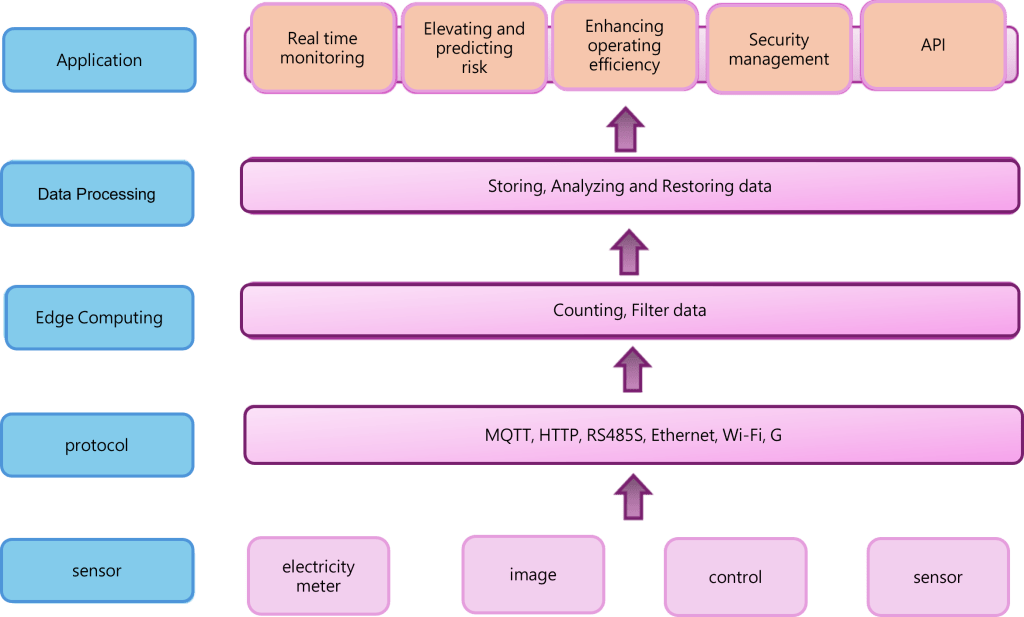
The frame of Industrial Internet of Things is an integrated IOT system and used to improve automatic, monitoring and analyzing data.
The first step is to achieve smart factory through Industrial Internet of Things (IIoT), we adopt an open architecture to allow customers to integrate easily and enables remote management through applications such as mobile apps, etc.
The core value of the Industrial Internet of Things (IIoT) is to optimize data-driven up to the best of business operations. IIoT can effectively enhance energy efficiency, equipment utilization, and management performance, while also reducing operational costs.
Functions
☆ Data Collection and Real-time Monitoring: Collecting various data from the production line and performing real-time monitoring to keep track of production status.
☆ Analysis and Prediction: Using data analytics to predict equipment failures, quality issues, and more, enabling proactive measures to be taken.
☆ Risk Management and Emergency Response: Establishing a comprehensive risk management system to respond quickly when abnormalities occur.
☆ Decision Support and Control: Providing decision-makers with the necessary data to support more informed decision-making.
☆ Reports and Dashboards: Generating various reports and dashboards, allowing users to quickly grasp key performance indicators (KPIs).



 和稻有限公司